 TaskMind
What is process automation with artificial intelligence?
A clear, jargon-free introduction to automation: what automating tasks in your business means and why it can change the way you work.
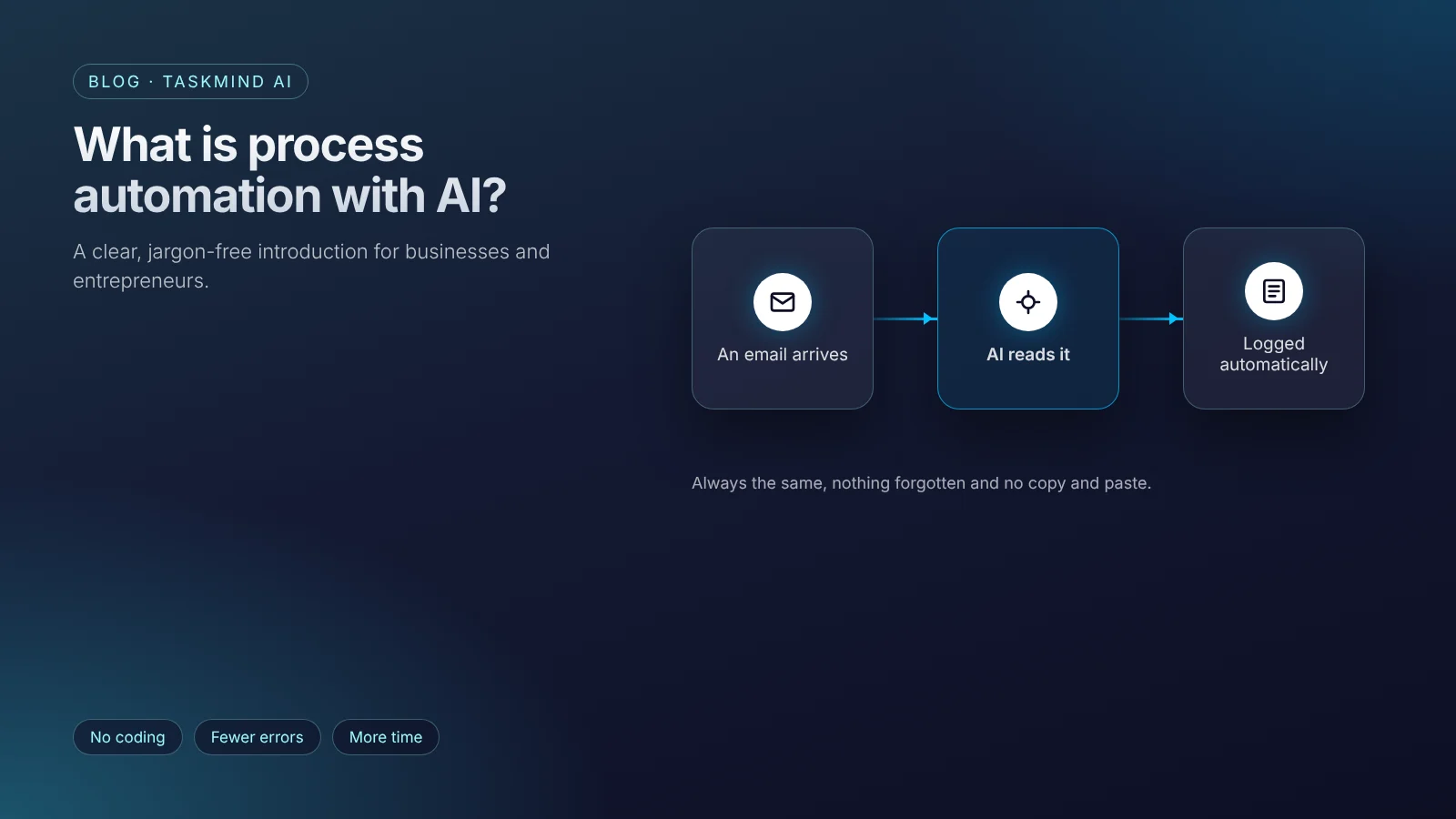
In recent years everyone has been talking about automation, artificial intelligence and efficiency, but many people are still unclear about what automating really means, or think it is only for big tech companies or industrial processes.
The reality is that any business, large or small, online or offline, can automate tasks. And it isn't about replacing people, but about freeing up time, reducing errors and improving the way you work with automatic, intelligent systems.
What does automating tasks mean?
Automating tasks means setting up a system that performs an action for you, without you having to step in every time.
Instead of doing a task by hand (for example, copying data from a form into an Excel sheet), you create an automated workflow that detects when something happens and acts on its own. And it always does it the same way: nothing forgotten, no errors and no need for you to keep an eye on it.
Simple examples
- When someone fills in a form on your website, their details go straight into your database and they receive a welcome email.
- You receive an invoice by email, it is saved in a folder organised by month and recorded in your accounting system.
- A client asks a common question and a chatbot replies with the right information without you having to answer.
Automating doesn't mean using robots or knowing how to code. It means putting in place solutions that make your business run more smoothly, with less operational workload.
Why is automating processes useful for your business?
You save time every week
The tasks you do every day take up more time than it seems. Automating repetitive tasks means getting those hours back.
You reduce human error
Copying and pasting, forwarding files, mixing up clients… All of those mistakes come with manual tasks. A well-designed automation doesn't make them.
You gain clarity and control
Automating forces you to define how you want your business to work. That gives you order, a clear view of the process and makes it easier to delegate.
You grow without getting overwhelmed
You don't need to hire someone every time you grow. With good automated workflows you can serve more clients without overloading yourself.
What kinds of tasks can be automated?
Almost any task that always follows the same steps. Some of the most common:
- Answering emails and frequent enquiries.
- Recording invoices, expenses and orders.
- Sending appointment, payment or renewal reminders.
- Moving form data and new contacts into your CRM.
- Generating quotes, contracts and regular reports.
- Organising documents and files into folders.
- Scheduling social media posts.
- Welcoming and following up with new clients.
The best part is that today there are accessible automation platforms that let you do this without coding, adapted to every need.
Automating isn't complicating things: it is simplifying them
A common mistake is to think automation is technical, expensive or cold. Done well, it is exactly the opposite: intelligent systems that work alongside you so you can focus on what matters, whether that is selling, creating, resting or growing.
It isn't about doing everything with AI, but about no longer doing what you don't need to do yourself.
How do you start automating?
- Identify the tasks you repeat often: emails, files, data, replies…
- Look at the steps you always do the same way: those are the easiest to automate.
- Look for tools or a consultancy in artificial intelligence and automation to help you put it in place without complications. You don't need to know how it works inside, just what you need.
Conclusion
Automating processes is neither a fad nor a luxury: it is a better, lighter way of working with less friction.
If you feel you do the same thing every day, repeat processes or struggle to move forward because you are always busy with operational tasks, AI process automation may be the change you need.